
The LIC and LARP host a panel presentatiuon on “The Road to 1559” by Stephen Kaufman
IC Co-Hosts Panel Presentation on “The Road to 1559” in New York
February 14, 2012
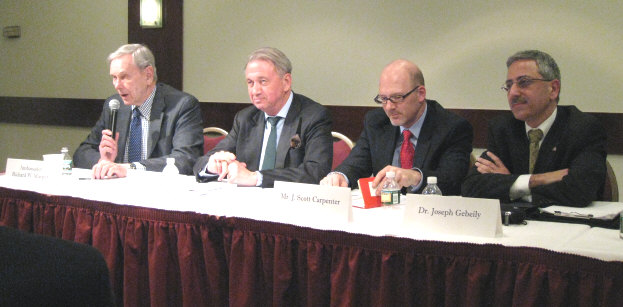
The Lebanese Information Center (LIC) joined the Lebanese American Renaissance Partnership (LARP) in organizing and co-hosting a panel presentation on the the book “The Road to 1559” by Stephen Kaufman. The event was set at the Beekman Hotel in Manhattan, NY and attended by a number of foreign diplomats from the United Nations, representatives from think tank Institutes, and members of the general public. The panelists were Ambassador Richard Murphy, former Assistant Secretary of State, Ambassador Terje Roed-Larsen, UN Special Representative for the implementation of UNSCR 1559, Mr. J. Scott Carpenter, former Deputy Assistant Secretary of State for Near East Affairs, and Dr. Joseph Gebeily, LIC President. Mrs. Rita Zehinni, New York correspondent for the Lebanese Broadcasting Corporation moderated the event.
Mr. Walid Maalouf, LARP president and former US Public Delegate to the UN gave the opening remarks starting with a request for a moment of silence in memory of the martyrs that fell in defense of the sovereignty and freedom of Lebanon, as well as in memory of late PM Rafiq Hariri on this 7th commemoration of his martyrdom. Mr. Maalouf then proceeded to welcome the audience and the panelists and to thank the Lebanese Information Center and its president, Dr. Joseph Gebeily, for co-hosting the event. He then proceeded to providing a succinct presentation on the period that preceded the passing of 1559 and the numerous preparations that went into it.
The first of the presenters was Ambassador Richard Murphy who gave a brief history of his involvement in the Middle East Diplomatic Mission during his tenure, and the persistently negative role that the Assad Baathist regime played in Lebanon.
Ambassador Terje Roed-Larsen then assumed the podium detailing the period following the passing of 1559. Ambassador Roed-Larsen considered that the martyrs of the Cedar Revolution were martyred because they supported the resolution. Ambassador Roed-Larsen disclosed that he had warned PM Hariri of the mortal threat against him a mere 48hrs. prior to his assassination and implored him to leave Lebanon. He then proceeded to describe the arduousness of his mission and considered that the current events in Syria are the biggest proof to the brutality of the regime.
Mr. J. Scott Carpenter, former Deputy Assistant Secretary for Near East Affairs, explained that the goal of 1559 was to assist the Lebanese people in their quest for freedom and sovereignty, lauding the immense sacrifices of the Lebanese and considered that the Syrian people are today, in turn, enduring these same hardships against the same regime. Mr. Carpenter then moved on to express his appreciation and admiration of the Lebanese-American community and its leadership in lobbying for the resolution.
Dr. Gebeily concluded the panel presentation with his remarks where he highlighted the efforts of the Lebanese-American community and organizations. He described the exceptional set of circumstances that surrounded the birth of 1559. A set of circumstances that he described as the convergence of 3 separate tracks:
1. The American track, with the evolution of American foreign policy under the Bush administration: “from a practical indifference towards the Syrian occupation to a solid commitment to Lebanese Sovereignty.”
2. The Lebanese track, and the evolution of the political environment to one which supported the voice of opposition to the Syrian occupation.
3. The resurgence of American Lebanese activism in the US which worked tirelessly to lobby the US government and the UN to support the sovereignty of Lebanon.
Dr. Gebeily then highlighted the invaluable role of patriarch Sfeir in fostering the environment that lead to 1559 and considered this resolution as the signal of the end for the rule of Bashar Assad.
The event concluded with a Q&A session.